Taking it to the Next Level – Ohio State Buckeyes
10/21/2006 12:00:00 AM | Football
Oct. 21, 2006
Complete Story in PDF Format
Download Free Acrobat Reader
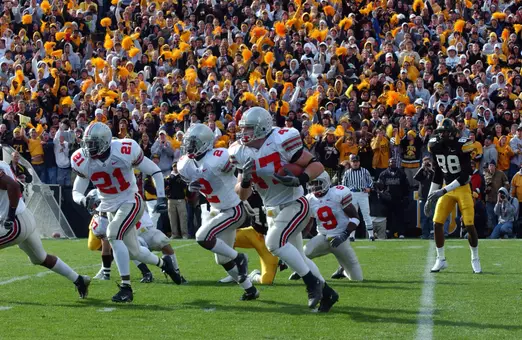
It was a hot, Saturday night deep in the heart of Texas, but the Buckeyes kept pounding away at the second-ranked Longhorns. Not the heat, not the record-crowd rooting against them, not the defending national champions could get past top-ranked Ohio State’s defense or slow down its offense.
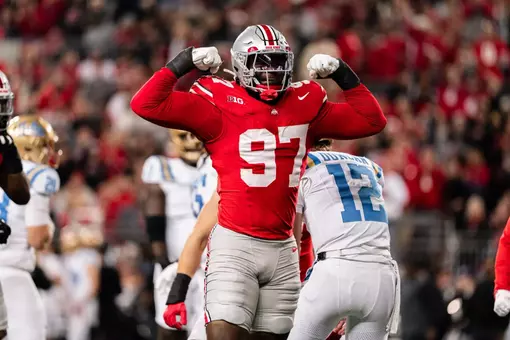
Texas, as other Ohio State opponents have found out this season, could not match the Buckeyes’ inner strength, which has them poised for a run at the national championship.
As he looked on from the sideline that night, Eric Lichter was not surprised, because the Buckeyes’ inner strength is there in part because he helped put it there.
Since he arrived in Columbus this past June, the Ohio State director of football performance has set about the task of not just making the Buckeyes bigger, faster and stronger, but redefining how they go about doing that.
“Strength and conditioning has evolved,” Lichter said, sitting inside the Ohio State football temporary weight room, known as “The Yard” on the indoor field at the Woody Hayes Athletic Center during one of the facility’s rare quiet times. “In the past, the thought of getting football-ready meant just weight lifting and running, but now there are so many other things involved.”
To help Lichter handle all the components of a strength and conditioning program that serves one of the nation’s most elite football programs, he has a staff that helps make it elite. He is assisted by Joe Rudolph, a former NFL offensive lineman and former graduate assistant coach at Ohio State, and Butch Reynolds, a world record holder on the track and three-time Olympian, who is one of the few full-time speed coaches in college football.
Together, they have helped take Ohio State’s performance level to new heights. To say they have it down to a science is exactly the correct description.
“It’s not just about strength,” Lichter said. “It’s about multidirectional speed, agility, flexibility, reaction time, recovery, nutrition, rest, nutrients, monitoring body stress, balance, rehabilitation and functional rehabilitation. We are more physiologists than anything else.”
Scientists, yes, but part coach, too, which helps them be even more effective in their work with student-athletes. Their experiences as college student-athletes themselves also add merit to their instruction. Lichter played middle linebacker at Weber State in Utah, Rudolph was an All-Big Ten guard at Wisconsin and Reynolds was an All-American on the track for Ohio State.
It does not stop with those three men. Assisting them in the strength and conditioning program are former Buckeye and NFL veteran Ahmed Plummer, volunteer coach Todd Murgatroyd, intern Jay Hooten and volunteer graduate assistant Andrew Winkler.
As valuable as they are, however, they will be the first to tell you they are just one piece of the puzzle that goes into preparing the Buckeyes for success.
“Football is still football,” Lichter said. “Whatever part we contribute on Saturdays, there is a lot more that goes into determining if a player performs well. It depends on things like how well he was coached and his film study. Football still has more to do with football than anything else, but whatever part we play from the weight room and running is about their strength and physically preparing that body.”
With Rudolph on staff, Ohio State is in the unique position to have not only a “coach in the weight room,” but to have someone who can directly relate strength training to movements players use in a game.
“You never see a bench press or a squat rack on the football field,” Rudolph said. “So I try to relate it to something on the field. It’s how you relate it to what happens when the ball is snapped.”
With 20 years of national and international experience with world-class coaches and athletes, Reynolds applies his detailed knowledge of running to the Buckeyes at every position.
“There are not many places where they use a system that includes a full-time speed coach,” Reynolds said. “Coach (Jim) Tressel has made a wave by doing that because it’s a whole new system. Within that system, we work on linear speed, lateral speed, bursts, explosiveness, quickness, hip movements, form and technique. Rhythm and breathing are very important and I focus a lot on the arms, feet and hips – things that accentuate running.”
With a staff that focuses on the little things, it is the one big thing – winning – they always keep foremost in their work.
“You judge success as our role in helping the team win,” Lichter said. “You always keep the team goals in mind. The challenge is to see what kind of impact you have on the team. We, as a staff, take a lot of pride when you see a guy make a play out there. When you see them do well on the field and experience personal success, his victories are somewhat our victories.”
The path for those victories is one that is built continuously throughout the year. It begins during the long, cold winter months when the Buckeyes report for 6 a.m. team lifts, which more than anything build team unity. When summer arrives, getting ready for the upcoming season takes top priority.
“From about mid-June on, the goal is to get football-ready,” Lichter said. “Before that, the first couple weeks of the summer are about a lot of volume and a lot of hours in the weight room. There are a lot of sore legs, longer reps and less rest time combined with running. We try to peak athletes for a season right before they go into camp. At that point, we’re not worried about test numbers. That’s not the time to be going after that.”
Even during the season, the team continues regular workouts, but the strength and conditioning staff alter the regimen to optimize each players’ performance when it matters most – on Saturday.
“From week to week, the challenge is to keep the bullets ready to fire,” Lichter said. “In-season, it’s about maintaining strength and power, so we lift heavy in order to stimulate, not annihilate, the muscle fibers. In the summer, we annihilate them and change their physiological makeup. And actually so far this season, a lot of the guys are even getting stronger. Their power capabilities in their Olympic lifts are going up, some of them even 25 pounds. That’s hard to do.”
After the regular season, the cycle starts over again. At that point, the staff gets back to the basics with each player and focuses on the fundamentals.
“If we have earned a bowl game, we take a couple weeks after the Michigan game to get the bounce back,” Lichter said. “Then during the winter, it’s about working in a close environment and with form and technique, especially with Butch. We work a lot on linear speed and continue to work on explosion in the weight room. We work quite a bit on the core lifts and compile more data about each kid.”
Specialized training, which took Reynolds to a place among the fastest men in the world, is something he now passes along to the Buckeyes. It is more than just related to technique, though, and Reynolds does not have any difficulty focusing on a different sport than track and field.
“From June to August we do explosive speed work, like hill running and stadium steps,” Reynolds said. “When we transition to two-a-days, we don’t do a lot of that anymore. Coach Tressel says our biggest job is to get the guys football-ready.”
That task is something personal for Lichter, who overcame a neck injury and two serious knee injuries to finish his own football career in college. From countless hours in the weight room recovering from his injuries, his passion for strength and conditioning was born and it took him into private business in the Cleveland area, where he co-founded two Speed and Strength Systems Training Centers.
There, he trained athletes in all sports from all levels, from high school teams to professional superstars, including LeBron James of the NBA and Ron Dayne of the NFL. In all, he trained more than 35 current NFL and NBA players and around 25 current or former Buckeyes.
“Sport-specific training is a buzz word out there today,” Lichter said. “For us, it’s taking a technical skill set our coaches want our kids to have and design a training program with those in mind. To create a physical enhancement program, you have to bridge the gap.”
Lichter’s experience as a small business owner has given him the ability to balance not only relationships with coaches and players, but individual and team goals.
“The biggest thing I want to bring is a focus on each individual and break down training by position,” Lichter said. “There should be variations from position to position and even within some positions. A big goal of mine is to tailor workouts to each athlete but to always keep team unity in mind. For example, on Fridays during the summer we would do a team lift and we would have 100 guys in here. What mattered was the team atmosphere.”
That philosophy is not lost on the members of the team, who look at the strength and conditioning staff as mentors and even counselors.
“We deal with the kids everyday,” Rudolph said. “We talk with them a lot and find out how they’re doing in all areas of their life. We often talk them through some things and help them to keep focusing. It’s more than just weightlifting. Jim Tressel has created an incredible culture. We just help facilitate that culture.”
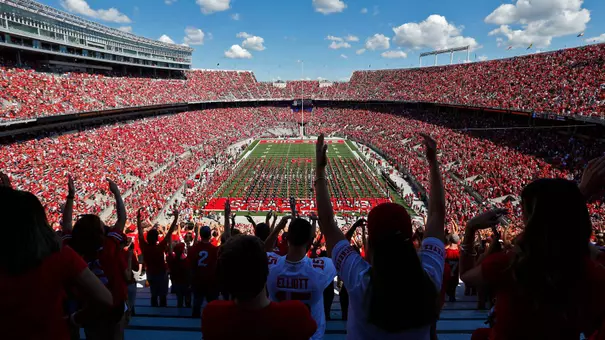
“We’re with these guys more than anyone else at this university,” Reynolds said. “If you’re not dedicated and if you don’t sacrifice, you won’t make it here. But the rewards are so great. To have more than 100,000 fans cheering for you at home, or cheering against you when you’re on the road, I love it. It’s all a learning experience.”
That learning experience is one the strength and conditioning staff has gone through and now applies to how they teach and work individually with each player. It is a system that has proven affective and the results on the field speak for themselves.
“We stick to the science,” Lichter said. “The biggest thing is to understand why we do certain things. We try to debunk myths about a lot of things related to strength and conditioning and educate each kid on the best way to accomplish something, because if they understand why they’re doing something, they’ll buy into it and work harder. We try to make things make sense from a scientific standpoint.”
With the staff in place to make Ohio State the best it can be, soon the program will have a facility to match. Next year, the renovations to the Woody Hayes Athletic Center will be complete and with them, the strength and conditioning staff will have the latest resources at their fingertips.
“I can’t tell you how exciting it will be for the players to have a facility like that,” Lichter said. “When it’s finished, today’s recruits and the current players, along with the guys in the pros who come back to work out, will have a facility that is on the cutting edge. It will be an amazing, wonderful facility. We will have no restrictions on what we can do there. We will be able to do everything you can think of.”
The combination of a state-of-the-art facility and a staff that is second to none will continue to give Ohio State a competitive edge. The environment, Lichter said, is key, but so are the people who control that environment. For the Buckeyes, they have the best.
“We get in the weight room with them and work hand-in-hand with the athletes,” Lichter said. “We’re constantly there to make sure they have good habit and technique and to monitor their biomechanics. We try to set them up to be successful.”