Synchronized Swimmers Repeat Tradition of Success – Ohio State Buckeyes
9/16/2002 12:00:00 AM | Artistic Swimming
Sept. 16, 2002
Twenty-two.
That’s the number of national championships won by Ohio State’s synchronized swimming program since 1977. Twenty-two championships in twenty-six years is quite an accomplishment.
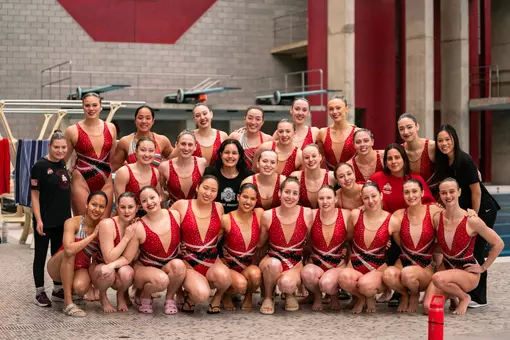
Ohio State head coach Linda Litcher-Witter is no stranger to success, as she has coached the Buckeyes to five national championships and two national runners-up finishes in her seven years as the Buckeye mentor. Litcher-Witter, only the third Ohio State head coach in program history, has continued not only a winning tradition, but also is continuing to build recognition the sport is receiving at a national level.
“When I came here, there was already an amazing program established,” Litcher-Witter said. “(Ohio State) had won more national championships than any other school. I wanted to keep the program going and take it to another level. Synchronized swimming is an emerging sport, so it is also a goal to help develop other programs in the country and try and get other Big Ten schools to include synchronized swimming in their athletic department.”
Litcher-Witter admits how difficult training is if you’re a synchronized swimmer. It’s harder that it looks, and it looks extremely hard if you are a spectator.
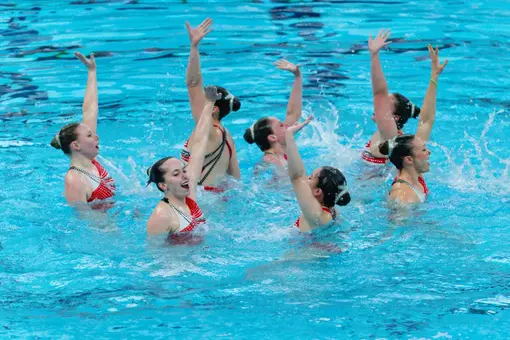
“Synchronized swimming is definitely a hard sport. It’s like running a 10K holding your breath,” Litcher-Witter said. “You have to have the strength of a competitive swimmer, the callisthenic awareness of a diver and the flexibility of a gymnast. You have to continue with your conditioning and training and then add the choreography and trying them out, doing lifts and other movements. It takes an enormous amount of time. We spend a lot of hours in the pool.”
An Ohio State synchronized swimmer trains in many different areas, from running and swimming, to lifting weights and doing a variety of flexibility and endurance exercises. Assistant coach Holly Vargo-Brown, a synchronized swimmer at Ohio State from 1981-84, and volunteer assistant coach Annemarie Litcher assist Litcher-Witter in focusing on the different aspects of training and competition. Brown’s primarily responsibilities focus on the strength and conditioning endeavors and making the “B” team athletes ready to be “called up” whenever necessary.
“Holly is going into her eighth year with me,” Litcher-Witter said. “She is very strong on knowing all the current techniques of the sport.”
After working on their physical training, athletes practice movements in water, putting their motions to music and working on moving in sync until it’s perfected.
“They are very musical,” Litcher-Witter said, “because you have to be able to count music and everybody has to do it at the exact same time.”
Annemarie Litcher, Litcher-Witter’s daughter-in-law serves as the team’s choreographer.
“She has all these visions and is able to put these amazing movements together with music,” Litcher-Witter said.
Physical training and musical talent are only two pieces of the puzzle.
A positive mentality is a must for every synchronized swimmer. Visualization of the correct movements, the timing on lifts and feeling the people around them are all part of the mentality the athletes endure both in and out of the water.
“If one person doesn’t get there or is a little off, the whole thing goes bad,” Litcher-Witter said. “These kids give up a lot. They train very hard.”
Synchronized swimming competition involves four events: solo, duet, trio and team, which consists of eight members from a school moving together in water.
There had never been a duo or trio that had won an individual national championship all four years until 2002.
Twin sisters Isabela and Carolina Moraes, products of Sao Paulo, Brazil and members of the Brazilian Olympic team, became the first duet in collegiate history to win four national championships when they won gold in Norton, Mass., last March.
The Moraes sisters teamed up with Mary Hofer to win the trio event for the fourth-consecutive year, breaking another national collegiate championship record.
“I don’t think that will ever happen again,” Litcher-Witter said. “I don’t think there will be two freshmen or three freshmen that you can put together that will be able to do that. It was amazing.”
“They are such fine athletes and I always felt working with them helped me be a better coach for my athletes,” Brown said. “I think it will be a very long time, if ever, that their accomplishment will be repeated. It has a lot to do with being in the right place at the right time. People have become National Champions in some cases because there wasn’t anyone good enough to challenge them. With these three, there were all kinds of really good people challenging them and they just proved to be the best.”
Isabela Moraes, Hofer, Victoria Bowen, Suzanna Hyatt, Kim Lester, Isabela Moraes, Beth Kreimer, Lauren Marsh, and Kristin Price were members of the team competition that won Ohio State’s twenty-second National Championship last spring.
Both Litcher-Witter and Brown know how special a national championships is, and with the continued success of the Ohio State synchronized swimming program, there is still a lot of pressure to keep on winning.
“It’s an incredible feeling (to win a national championship), but at the same time, it’s a tough thing to keep on doing,” Litcher-Witter said. “Developing a program is one of my most favorite times to be involved, because you can really grow. When you’re up on top, everybody is rooting against you and wants to see someone else win. You want to just be as good as you can be, have a fair program and have people say nice things about it, but there is tremendous pressure.”
“The tradition is so deeply ingrained,” Brown said. “Incoming athletes always know they have big shoes to fill, but I think it allows them to rise to the challenge. Of course there is always pressure to repeat your past successes. Linda and I try to focus on constantly improving the skills of every athlete training with us. With a little luck, the rest just might take care of itself.”
While every national championship is certainly very memorable, perhaps the one that sticks out the most came in 2000. Alumni, friends and family were invited to the watch as Ohio State hosted the championships at the Mike Peppe Aquatic Center in Larkins Hall. Stanford had previously beaten the Buckeyes in 1998 and 1999, so winning back the national championship in their home facility was a big achievement. Litcher-Witter even made her way to a tattoo parlor after the victory, engraving “2000”, with a red Block “O” as the last number zero on her hip.
“It was such a big deal, and I kept on motivating them by doing something crazy,” Litcher-Witter said. “It hurt like heck and I would never recommend it.”
Through all the national championships, teammates and memories, Litcher-Witter will continue the traditions of the synchronized swimming program at Ohio State.
“I love my job more than anything. I think the program is so well respected here. I think I have died and gone to heaven because it’s a great place to be. The program speaks for itself not only with winning and intensive pride and accomplishment, but also with all the things (the student-athletes) will leave here with and carry with them.”