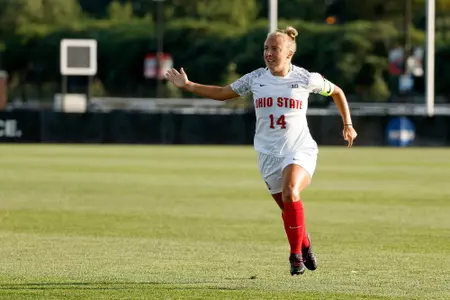
Vatne Striving to Help Athletes On and Off The Field
6/19/2023 3:41:00 PM | The People
When Emaly Vatne first arrived on Ohio State's campus as a freshman, she knew she was set up for success. She wanted a place that provided as much support and as many opportunities as possible both on and off the soccer field, and with its massive size and dedicated commitment to its athletes and students alike, Ohio State was the perfect fit.
"It's at the highest level. The quality and the opportunities are so high here," Vatne said. Reflecting on her recruitment process, she remembered being particularly impacted by the community she felt within the athletic department.
That type of cooperative atmosphere propelled her through a rollercoaster of a collegiate soccer career. Entering her freshman season after a brutal knee injury kept her sidelined for much of her senior year of high school, she made history as she was just the third first-year Buckeye to score a hat trick in a game. She played a significant role in the team's success in her sophomore season and quickly began to establish herself as a leader amongst her teammates.
Unfortunately, in the summer of 2022, she faced yet another injury as she was gearing up for her final year of eligibility; this time, a torn ACL put her season into question. However, a unique combination of her body composition and her recovery systems allowed her to continue playing without worsening or reaggravating the tear. While her role was more limited than it had been in the past, her leadership and presence on the field made her an important part of the team. Additionally, her injury allowed her to discover a new endeavor to keep her occupied outside of the turn her soccer career had taken.
She became involved with the Human Performance Collaborative, a team of researchers that study the different ways in which an athlete's behaviors can affect how they train and recover. This team operates as a part of the Performance Innovation Team, a group of Ohio State researchers, trainers and coaches that help find ways to ensure that student athletes are executing and recuperating on the highest possible level.
Vatne, who has "always been very science and math oriented," became interested in the data and analytics of athletic recovery following her ACL tear. The need for the rest of her mobility systems to be functioning at the highest level was magnified by the injury, so her athletic training coach suggested she begin using a wearable monitor. Similar tech was in the early stages of implementation across Ohio State teams to help track sleep, heart rate, respiratory rate, and more. This data helped Vatne better understand how her behaviors were affecting her recovery; as she discovered more about the implications of her measurements, she was immediately hooked.
"[My injuries were] what got me into pre-physical therapy in the first place and got me interested in research," Vatne described. As she learned about how the information she was collecting about her own recovery could be used on a larger scale, her area of interest shifted from PT towards analysis and data study.
"Tracking data and using technology wasn't necessarily novel…but what is unique is the application of that information," Dr. Jason Stone, a former member of the HPC research team, said. He helped with the push to utilize tools, like the tracker Vatne used during her recovery, to better inform teams about how to tailor their behaviors for the optimal level of performance.

Similar technology is common in college athletics, but the analysis and dissemination of that information is on a whole different level at Ohio State.
After starting as an intern with the HPC, Vatne transitioned into a graduate assistant role. She helps the team analyze the data that comes in from various teams based on what is measured by force plates and wearable trackers. She then helps create reports and infographics that are provided to coaches and players to help guide their training plans.
"Monitoring that stuff objectively and at such a high level of detail really helps us strategize what training approaches make the most sense, but they also make sure that our athletes are recovering so that when it is competition day, we know that they're ready to be their best," Vatne said.
The ability to provide the data that's most important and informative from a coaching and training perspective allows Vatne and her fellow researchers to support student-athletes and their coaches in staying focused on understanding and executing that information rather than monitoring it and trying to interpret it all themselves.
"We've got to educate and communicate to the staffs and the teams to take that stigma away of…so much data," Dr. Josh Hagen said. Dr. Hagen leads the HPC team. "It is a lot of data," he continued, "but our job is to simplify in a rational manner."

As a student athlete herself, her role on the team was that much more important in providing perspective on the information. As Dr. Stone said, "Who's going to be better to help us understand what the student-athletes want and need than student-athletes themselves?"
"She's lived the life of an athlete…she understands the grind," Dr. Hagen added. "As we are trying to educate the athlete on this, I didn't have the perspective of how busy they are." According to Dr. Hagen, Vatne was essential at providing those types of insights.
The research team also hopes to continue to expand their efforts and find new ways to apply the information they are monitoring. Having someone with first-hand playing experience brings a sense of "what athletes want to know and [what] questions would help them be better in their craft," according to Doug Calland, a member of the Performance Innovation Team implementing the research conducted by the HPC.
"The field is certainly growing and she's in an area now where I think we need to keep her around," he said of Vatne's role in this research. "She's infectious in her approach to how exciting it is…I think she's going to be a valuable asset."
Vatne herself stressed that ultimately, while this data has been revolutionary for optimizing player performance, there's much more to it than that. She recognized that "we're at Ohio State, so the expectation is to win championships, but we also want to make sure our student-athletes are healthy as well."
In fact, a big part of the role being played by the research team focuses on education for athletes beyond their Ohio State careers in addition to the things that can help them during their seasons.
"Student-athletes schedules are so set up for them, so when that structure falls away," Vatne emphasized, it's important to make sure they are "prepared to make good decisions."
"When you leave practice or you leave campus, you become an individual and you have to make your lifestyle decisions and habits," Dr. Stone said. This makes it all the more important for athletes to understand how their behaviors carry over from one branch of their life to another.
"It's not just about what's on the field; it's about the student athlete as a whole," Vatne explained. Despite hesitance from athletes hesitant about being monitored at the level of detail provided by some of this technology, Vatne hopes to teach them the value of the information on a larger scale.
As a former player, "I recognize that perspective that a student athlete might have," she said. She understands players who may not want their coaches to have access to their every move, but wants them to focus on the many ways this tech can help them as individuals beyond practical applications on the field.
After so successfully implementing this research into her own life, it's clear that Vatne is more determined than ever to make an impact on the greater sports world. Her assistance with this research will give countless student athletes the chance to perform at their full potential day in and day out.
"When you love what you do, adversity happens, but if you're clear about why you're doing hard things, it's not as difficult to go through," Vatne asserted, demonstrating a passion that shows no signs of fading.